Neuroscience & BCI · Health & Learning
How Do We Learn to Read Music?
Using psychological methods and eye-tracking to investigate the effectiveness of several popular approaches to music literacy.
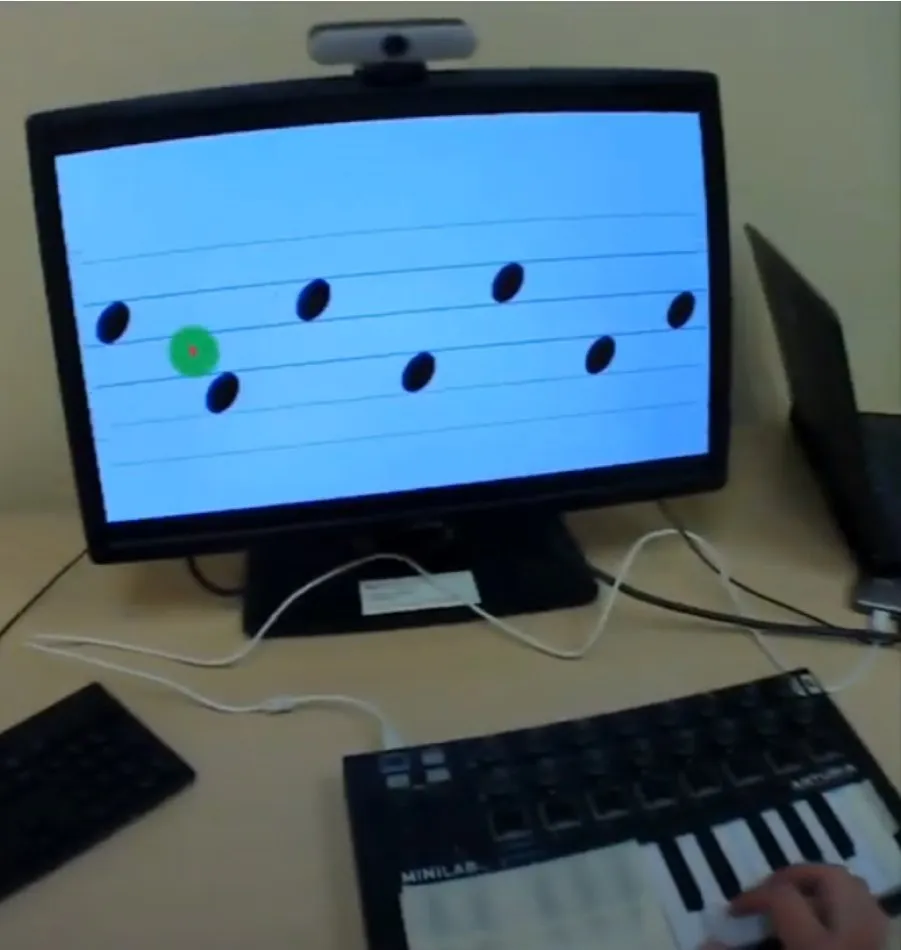
Traditional music notation is the backbone of Western music education, yet its effectiveness has rarely been tested empirically. Using psychological methods and eye tracking, I investigated how popular learning aids, colored notation and stickers on piano keys, affect how beginners learn to play.
Background
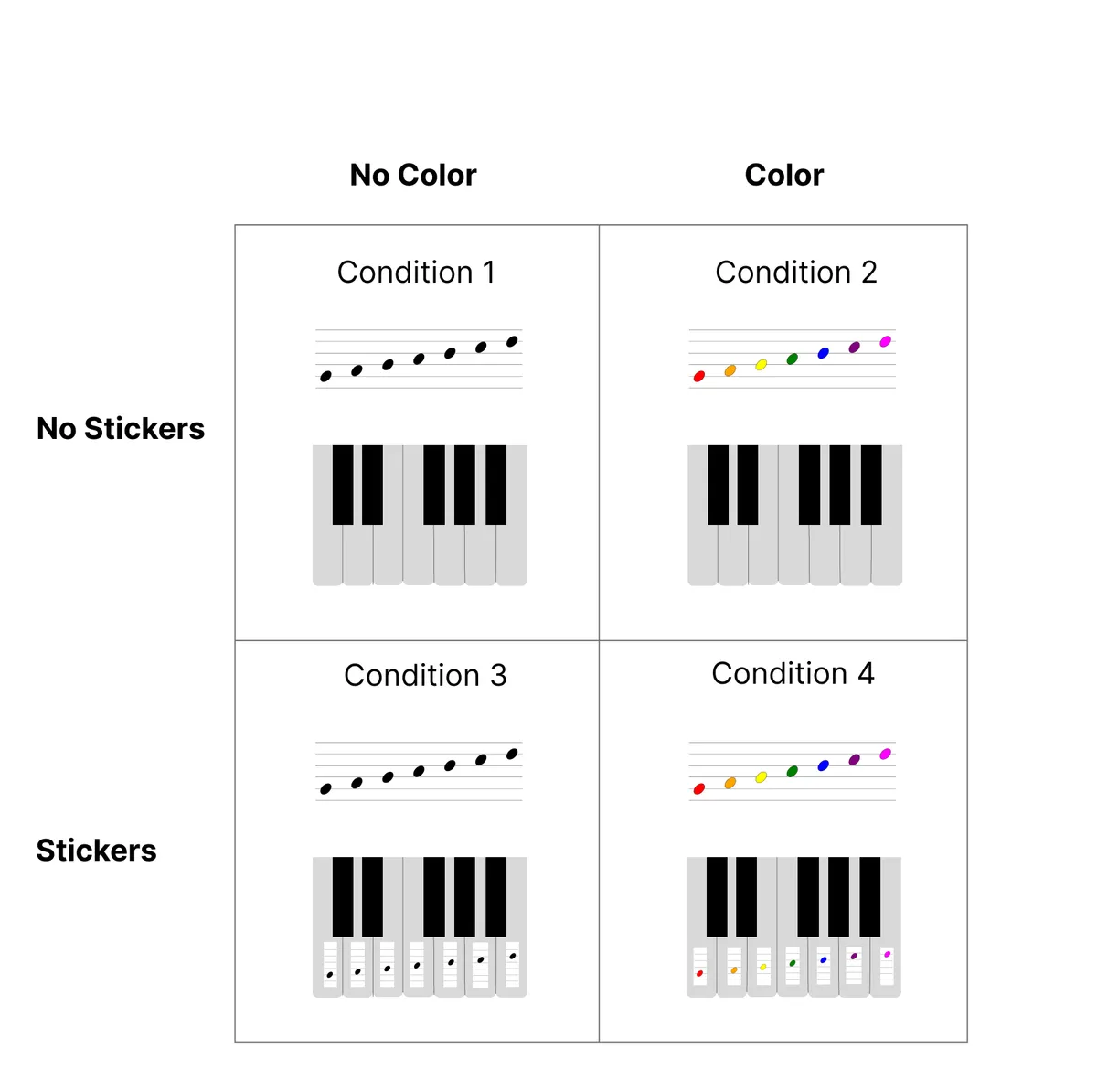
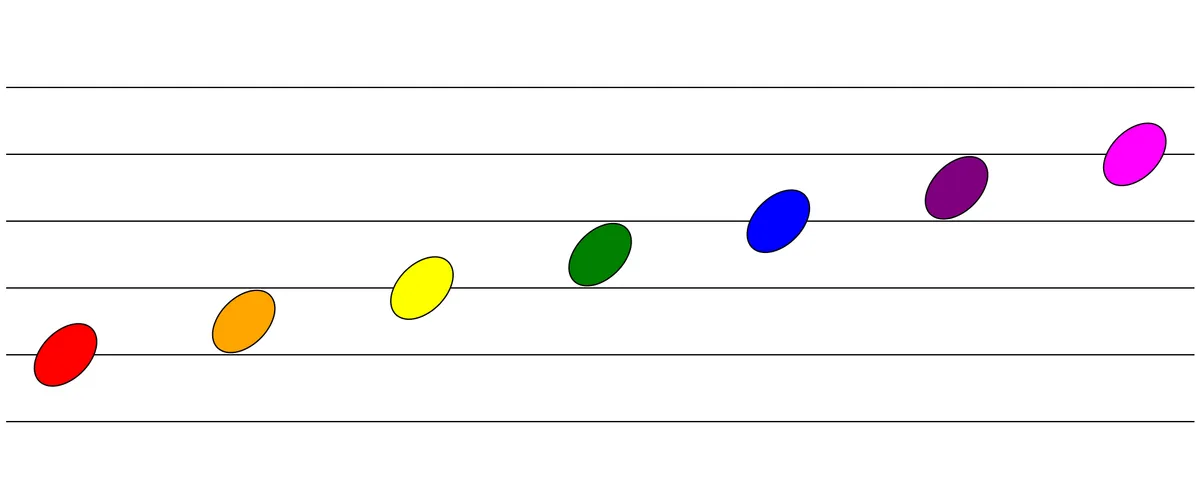
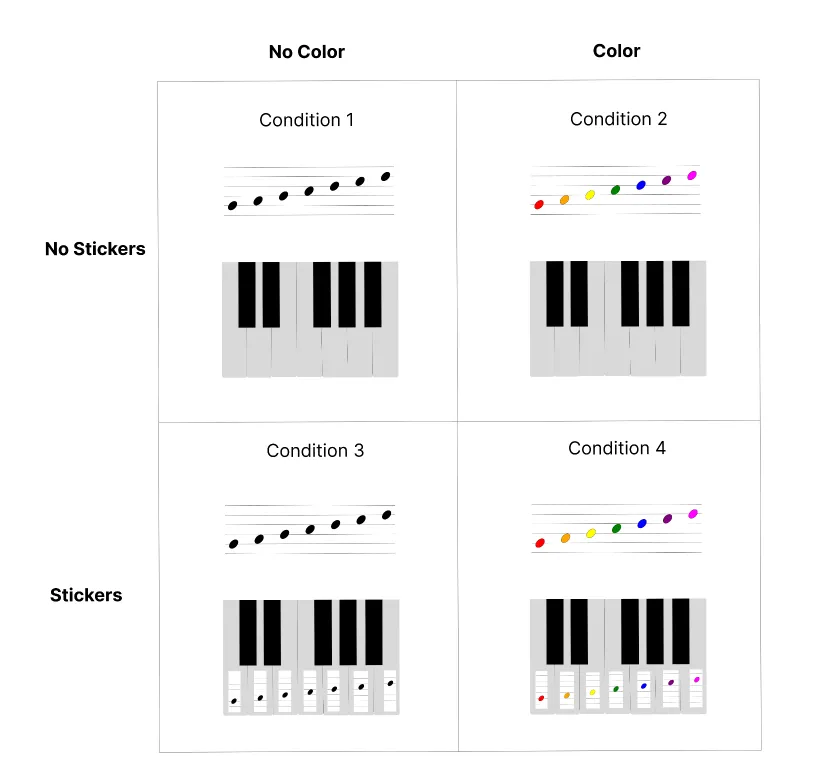
Learning an instrument is a dual cognitive task: understanding what a symbol means and translating it into a motor action. Color in notation and stickers on keys are widely used in beginner method books, but their effects on learning have rarely been measured. Drawing on theories of procedural learning, structural mapping, statistical learning, and guided visual search, I hypothesized that color would reduce the load of recognizing notes and that matching stickers would strengthen the mapping from notation to keys.
The experiment
In a between-subjects 2×2 factorial design (color vs. black-and-white notation, with vs. without key stickers), adults with no musical training played 80 seven-note sequences on a piano keyboard. The sequences were drawn at controlled levels of difficulty using transition entropy, a measure of how predictable each note-to-note step is. We recorded accuracy and trial time in PsychoPy, and used Pupil Labs Invisible mobile eye tracking to count how often participants looked at their hands.
Key findings
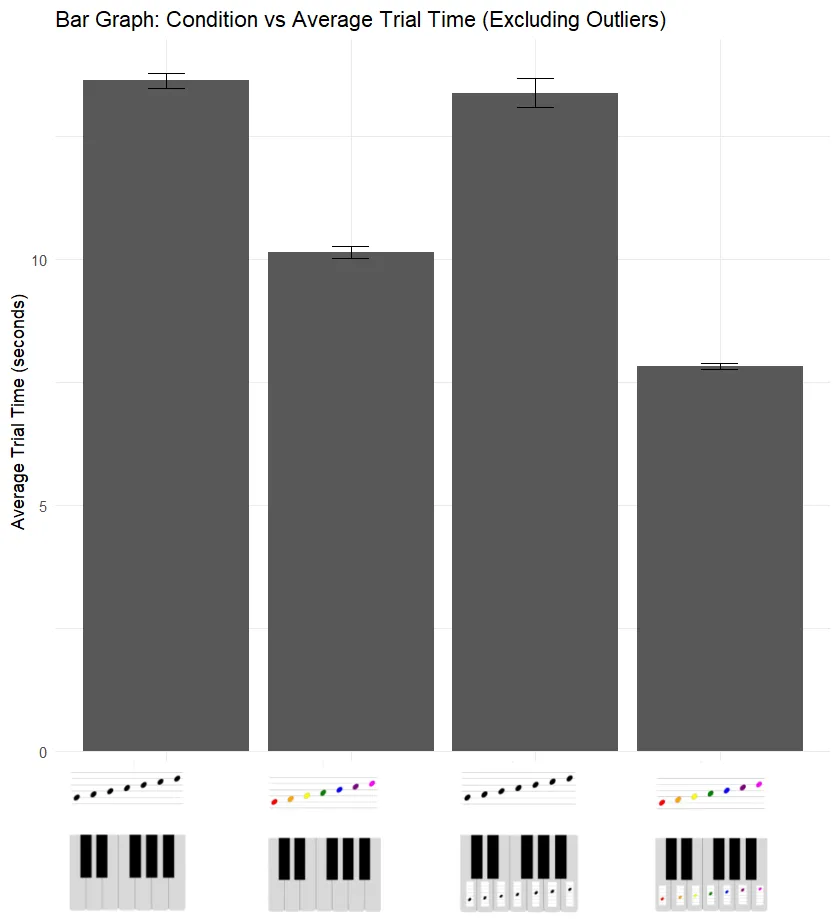
- In the first 85 participants, colored notation sped up trials considerably (≈10 s vs. ≈14 s per sequence).
- Color combined with matching colored stickers produced the highest accuracy (94%) and the fastest trials (≈7.8 s).
- Stickers paired with traditional notation lowered accuracy. Reinforcing a poor representation with symbol mapping can make performance worse.
- Visual aids work best as a coordinated system, not as isolated additions.
Gallery
Publications
-
Computer-Supported Music Improvisation
Ph.D. Dissertation, University of Colorado Boulder (ProQuest), Boulder, CO, USA, 2024.
Related projects
Embodied Symbol Systems
How visual features shape the symbol-perception-action loop in musical notation.
Jam Tabs
Investigating alternative, color-based music notation and tools for novice improvisation.
Custom Plugins for Music Notation Software
Plugins that manipulate notation software to aid reading and pedagogical techniques in music.