Neuroscience & BCI · Health & Learning
Embodied Symbol Systems
How visual features shape the symbol-perception-action loop in musical notation.
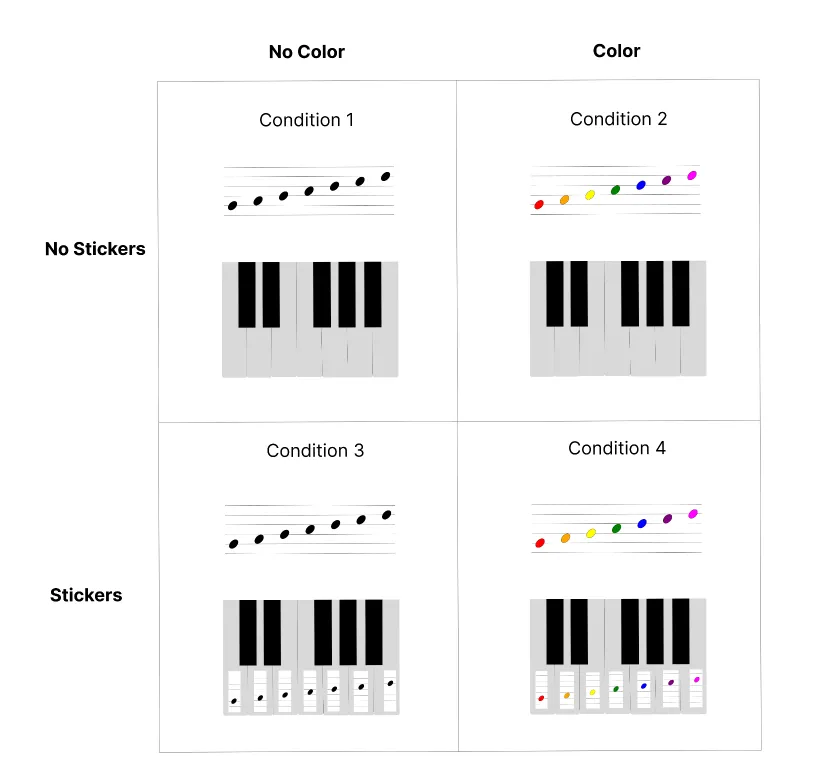
How do the visual features of a notation shape the loop between seeing a symbol, perceiving what it means, and acting on an instrument? This study tests how color and symbol-to-instrument mappings affect how complete beginners learn to play from notation.
The question
Traditional Western notation has remained largely unchanged for centuries, yet there is little empirical evidence about how well it supports learning compared with alternatives. Learning an instrument is a dual task: understanding the symbol and translating it into a motor action. Embodied Symbol Systems examines how visual features in notation, such as color and matching cues on the instrument, shape that symbol-perception-action loop.
The study
Grown out of Jam Tabs and the colored-notation experiments in my dissertation, this NSF-funded study with Lei Yuan had ninety adults with no piano experience learn to play from notation under different visual conditions. The paper is currently under review.
Publications
-
Embodied Symbol Systems: How Visual Features Shape the Symbol-Perception-Action Loop in Musical Notation
2026. Under review
Related projects
How Do We Learn to Read Music?
Using psychological methods and eye-tracking to investigate the effectiveness of several popular approaches to music literacy.

Jam Tabs
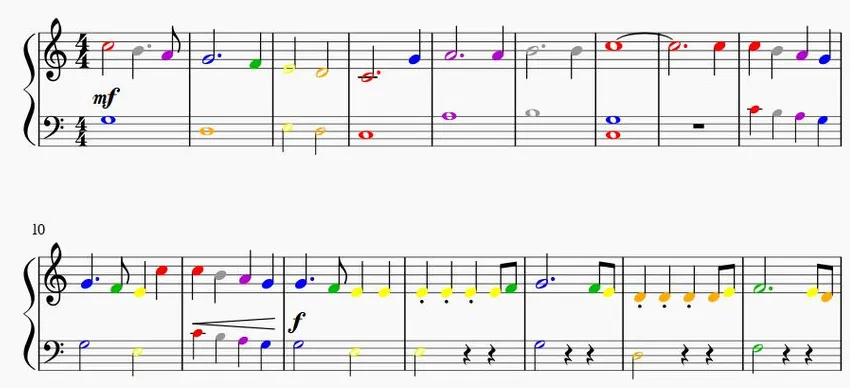
Investigating alternative, color-based music notation and tools for novice improvisation.
Custom Plugins for Music Notation Software
Plugins that manipulate notation software to aid reading and pedagogical techniques in music.