AI & Music
Linguist vs. Machine
Comparing machine learning algorithms with trained linguists at uncovering morphological grammar rules.
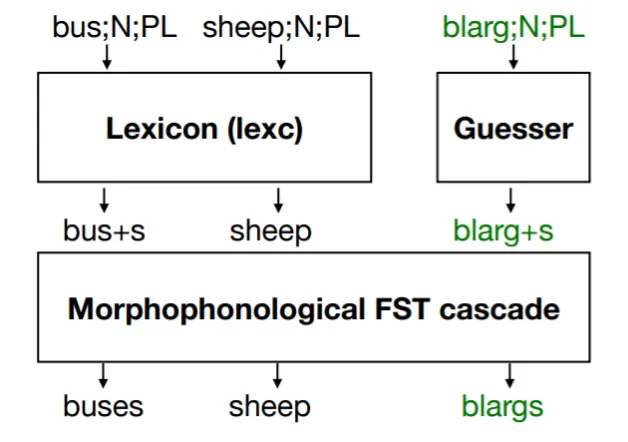
Can linguists writing grammars by hand beat neural networks at learning word inflection? As part of a large team, I helped develop 25+ finite-state morphological grammars and compared the effort and accuracy against sequence-to-sequence models.
Approach
Each grammar combined a lexicon-based model with a "guesser" for unseen words, built as a cascade of finite-state transducers. We also built tools to help linguists triage difficult morphophonological phenomena and hypothesize inflectional class membership.
Key findings
- Surpassing neural models’ accuracy required significant development effort by trained linguists.
- The paper weighs the cost/benefit of hand-written grammars, which is especially relevant for low-resource languages.
Publications
-
Linguist vs. Machine: Rapid Development of Finite-State Morphological Grammars
Proceedings of the 17th SIGMORPHON Workshop on Computational Research in Phonetics, Phonology, and Morphology, pp. 162–170, 2020.
Related projects
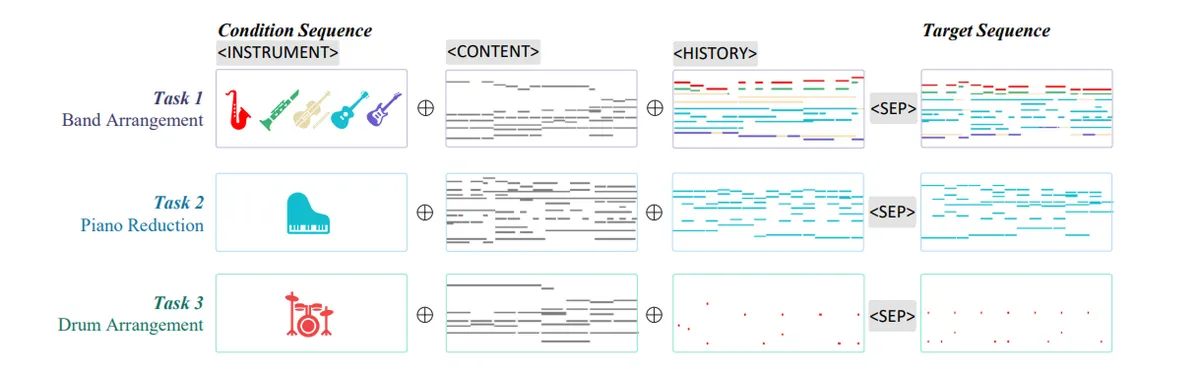
Automatic Arrangement
A unified framework and neural network architecture that enables automatic multitrack music arrangement.